


- Narrator and neighbor Mogens Jorgensen traveled from Regina to Wadena to explore rural life and visit Mogen's former hometown.
- They discussed personal histories, comparing traditional life in Canada and Nepal with Canada's rapid agricultural and technological development.
- In Wadena, the narrator attended a historic church service where Mogen delivered a sermon and engaged with the local community.
- The trip concluded with reflections on generational changes and the preservation of family history through visits to ancestral homes.
Several days earlier, my daughter’s close neighbor, Mr. Mogens Jorgensen, in Regina, Saskatchewan, Canada, had told me that he was planning to visit a small town about two hours away on August 9. He said that if I was interested in going for a drive and looking around, I was welcome to join him, and that we could arrange a suitable time. Mogens had previously lived in that town, Wadena, and had seen many of the surrounding places. As I am very interested in learning about diverse cultural and social life, and I had been thinking about exploring the countryside and observing rural life, I happily accepted his invitation.
I was eagerly looking forward to August 9. The previous day, August 8, I asked my daughter, Sarita, to prepare breakfast for the next morning as well as lunch for the journey. We were supposed to leave at 8:00 a.m. She did not object at all. Instead, she said, “All right. You will get to see a new place, and I will also be happy because it is a place where Mogen used to live.” He is a friendly, helpful, and positive person and has been a very good neighbor. Walking around with him would also be an opportunity to learn more about the area. My daughter felt that going with him would be a good experience. Her encouragement made me even more curious and eager. I know she wants to see me smiling and happy all the time.
Today was August 9. I got up early in the morning. After completing my daily chores, I went to my daughter’s house with my wife at exactly 7:00 a.m. Mogens had sent a message saying that he would be ready at 7:45. Following his instructions, we quickly ate breakfast—bread, eggs, and fruit—and prepared lunch for the afternoon, which we packed in a bag. We also brought drinking water and coffee.
At exactly 8:00 a.m., we set off from Regina toward our destination. As we were leaving, my daughter asked Mogens to teach me about the area and the places we would be visiting.
We had to travel northeast. The destination was about 200 kilometers away and would take roughly two hours to reach. Mogens had already told me about the journey beforehand. He sat in the driver’s seat, and I sat beside him in the front passenger seat. I fastened my seat belt, and we continued on our way.
From early that morning, clouds had covered the sky, and the weather forecast had predicted a possibility of rain. It felt a little cool. I wore a T-shirt and a light jacket, while Mogens wore a thin sweater. However, I did not really feel the cold inside the car. The road was wide and smooth, without potholes, and there was hardly any traffic. The highway looked almost empty. Green fields stretched out on both sides of the road.
Because this is a completely flat region, the greenery seemed to extend far into the distance. In some places, the fields appeared to contain wheat, while in others there were mustard or lentils. The crops would probably be ready for harvest in about a month. I learned that the seeds used here are specially prepared for this region by agricultural scientists and can mature in about 90 days.
Occasionally, houses could be seen near the roadside and among the fields. Large grain-storage bins were also visible. I learned that farmers use these bins to store and sell grain, lentils, and other agricultural products. These were the homes of farmers, with no large settlements nearby.
After driving for about an hour, we arrived at a small town called Fort Qu’Appelle. I had been there many times before. My daughter’s husband, Jwai Uddhav, used to live there and still works there. He continues to travel back and forth for work. We stopped there to use the washroom and have some coffee. The weather outside was pleasant. It was enjoyable to look at the scenery on both sides of the road. There was greenery everywhere. Most of the land appeared green and fertile, while the population seemed quite sparse.
During the drive from Fort Qu’Appelle to our destination, we had many interesting conversations on a variety of subjects. We talked about Nepali customs and culture, Canadian culture, and matters related to Hinduism and Christianity. Mogen also shared stories from his own past.
He told me about coming to Canada from Denmark with his parents, settling in this area, living in a place where there had been very little infrastructure, and experiencing life before modern technology had developed. He talked about getting drinking water from wells, collecting firewood from the forest, village life, farming as a profession, and his experiences as a student. He explained how, when he was young, he had to work at home and help his parents. He also remembered having to travel to nearby Regina for shopping and medical treatment because there were no nearby markets. During winter, people had to burn coal and wood to protect themselves from the cold. He shared many such memories from his past.
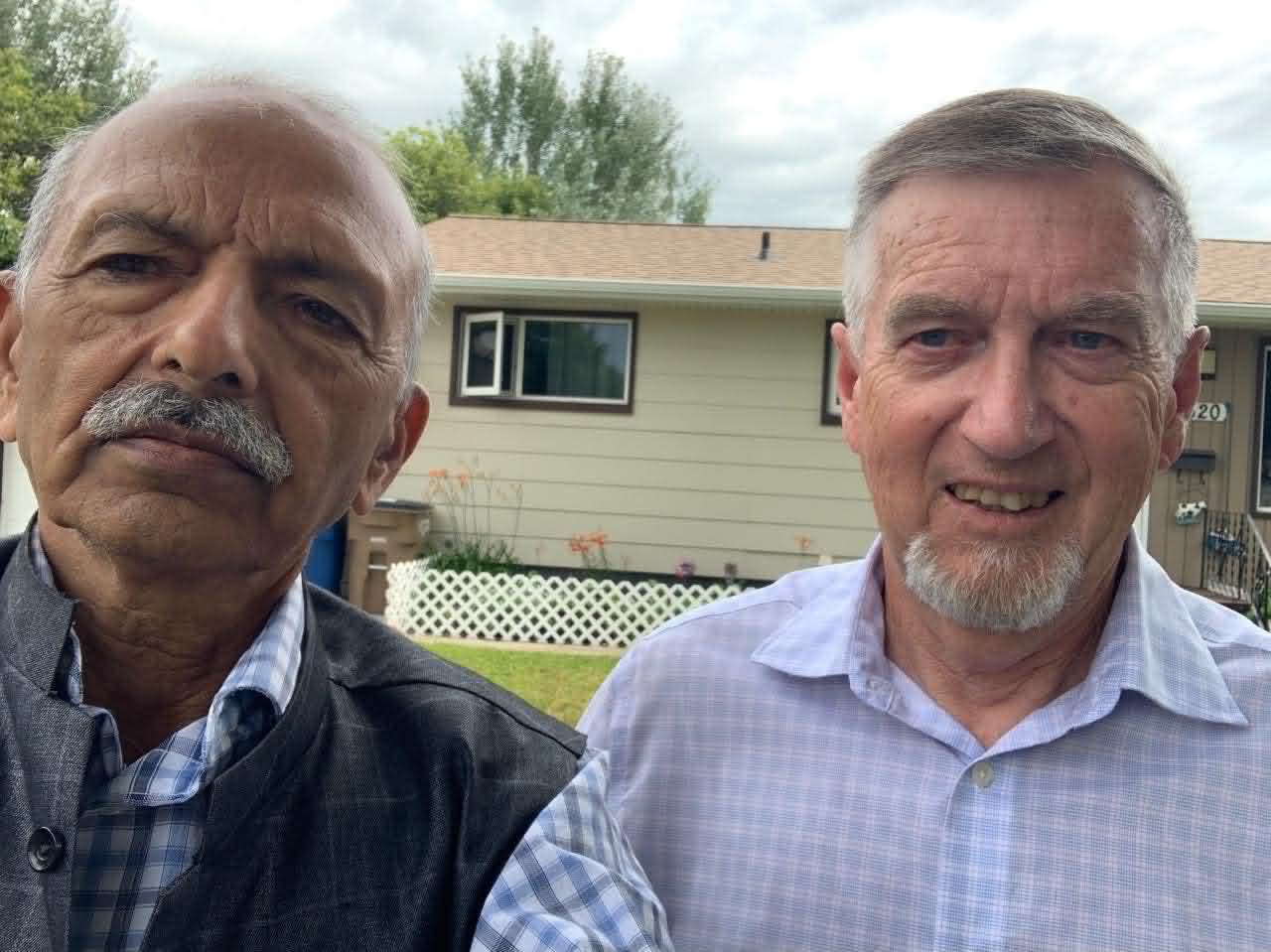
I also told him about my own past. In many ways, the conditions of my village and the circumstances I experienced were quite similar to what he had experienced. I realized that Canada today had, at one time, been similar in many respects to the conditions I had seen in my own village. It seemed that, over the past 40 or 50 years, rapid development had taken place in almost every field around the world.
Our conclusion from the conversation was that our generation had experienced a period of great transition. We had experienced both the old era and the new one. Our children, however, would not be able to experience that transformation in the same way. Having grown up in Regina, they would know very little about those earlier conditions. To them, many of the things we remember from the past might seem almost like fictional stories. Apart from my younger son, Suman, my other children had not personally experienced those conditions. I felt that, for our grandchildren, those experiences might seem even more distant and imaginary.
After driving for about two hours and fifteen minutes from Regina, we finally reached our destination, Wadena. There was an old church there, which I learned had been established in 1907. With the support of local people and assistance from the city office, a good building had been constructed. It was a spacious, two-story building that could accommodate around 200 people and host various programs.
People had gathered there and were waiting for Mogen. Around 50 to 60 Christians had already assembled. As soon as we arrived, the program began with a prayer. The prayer was religious in nature, and everyone was expected to stand, so I also stood.
After the prayer, a short video was shown. It appeared to document the church’s history of providing support and assistance to people who had suffered from the destruction caused by the Fort Qu’Appelle disaster. The video also showed something of the church’s history of helping people.
After that, the announcer introduced Mogen for the religious sermon. Following a few introductory remarks, he indicated that I should also be introduced. He said that I was Sarita’s father and had come from Nepal to visit and observe the area. He then asked me to stand.
I stood up and waved my hand. Everyone looked at me with curiosity and interest, and I felt that they were pleased to see me.
From the sermon Mogens had previously given at his church in Regina, I had already formed the impression that he was a mature, capable, and disciplined pastor with deep knowledge of his subject. His speaking style, choice of words, hand gestures, eye contact, facial expressions, and overall manner seemed to engage the audience. I especially liked the way he smiled and spoke while looking directly at the people listening to him.
He spoke continuously for about an hour. His sermon was based on the Bible. He said that Chapter 23 of the Bible was particularly important. I asked him about some words I did not understand, and he explained their meanings and significance to me.
After his sermon, there was another prayer, and the program ended. The event had been conducted in an informal and welcoming atmosphere.
After the program, I spoke with two elderly people and asked them questions about the area. I learned that farmers used to live there, but people gradually moved away and became increasingly concentrated in cities. As a result, the town could not develop into a major market center.
At present, there are about 500 houses and a population of around 1,500 people. It is an old and historic market town. Even though it is a small place, it has a school, health center, playground, park, and community building. The place is also well known among hunters.
The town is administered by a mayor. I also obtained some information from one of Mogen’s friends, Conrad Eliason, who is 79 years old. Coffee was also available in the church hall. Since I had brought coffee from home, I enjoyed my own coffee there. There were enough chairs for everyone to sit comfortably.
Mogens asked me where I wanted to sit. Since I wanted to take some notes, I chose a seat toward the back where I could observe everything. I really enjoyed the experience. Most of the people there were elderly. I also took a photograph.
After that, we went to see Mogens’s old house. He had lived there for several years during the early part of his life. Although many years had passed, it seemed that his memories of his old home were still very strong.
I also went to see the farmland around the house where I had once walked. It was a moving experience. It made me think that we should do things properly and never leave things neglected, because the sweat and hard work of our parents and grandparents may still remain in such places. It was truly amazing to see how much history could remain in one place.
We had brought our own food with us. While looking for a suitable place to sit, we found a small shelter near a park where people could sit and eat their own food. We sat on a bench, ate our lunch, and shared some conversation. After that, our return journey began.
We continued talking about many meaningful and relevant subjects. Mogens talked about everyday life, customs, traditions, and culture, comparing similarities and differences, while I also shared my thoughts and experiences. We discussed Hitler’s rule, the Russia–Ukraine war, Trump’s behavior, and many other diverse subjects.
He repeatedly said that because he had received a good education and had been able to make meaningful use of his life, he felt that his life had been worthwhile. We also talked about the major religions of the world, their historical backgrounds, and the influence they have had.
The visit also gave us an opportunity to have a broad conversation about the cultural relationship between Nepal and Canada. I felt that this kind of exchange should be continued. Mogens will soon be going to Vancouver, where he will stay for several months. We will also have to go there, and we agreed that we should meet again there.
His experiences and my experiences were, in many ways, surprisingly similar. The places were different—he is white, while I am brown; he is Christian, while I am Hindu; he is from the West, while I am from the East. Yet, despite the differences in our backgrounds, food, lifestyles, and cultural experiences, many things were remarkably similar from a human perspective.
I was very happy about this. From the perspective of social studies, the experience helped me understand something important: despite differences in geography and culture, there are many similarities among human beings.
Finally, what remained most memorable to me was the greenery on both sides of the road, the natural beauty, the wide and beautiful roads, the friendly behavior of the people at the church, the cool weather, the peaceful environment, the clean settlement, the beautiful appearance of the market, and, above all, the meaningful conversations we had along the way.
Nothing else occupied my mind during the journey. I felt relaxed as we drove and walked around. I became increasingly interested in learning about village life—the social relationships, people’s ways of speaking, their daily routines, their education, their experiences, and their way of life. I naturally wanted to compare all of this with my own background.
That is why I feel an increasing desire to travel around villages and rural settlements. I want to see and understand a way of life that is farther removed from the mechanical rhythm of urban life.
During our conversations, we did not leave any subject untouched. Although I cannot speak English fluently, I was able to understand what Mogens said quite well, and our conversation went very smoothly. I felt that I had benefited greatly from the experience.
Today’s journey was short, but it left an impression that I believe will remain with me for a long time. Thank you, Mogens, for giving me this lifetime-memorable opportunity to learn about the rural life of the area, particularly its ancient past, human life, and the struggles people faced to survive in rural communities.


